


When a patient misses a follow-up appointment, leaves a prescription unfilled or returns to the hospital shortly after discharge, health care providers often focus on what didn't happen.
At Kansas City University (KCU), students are learning to ask a different question:
Why?
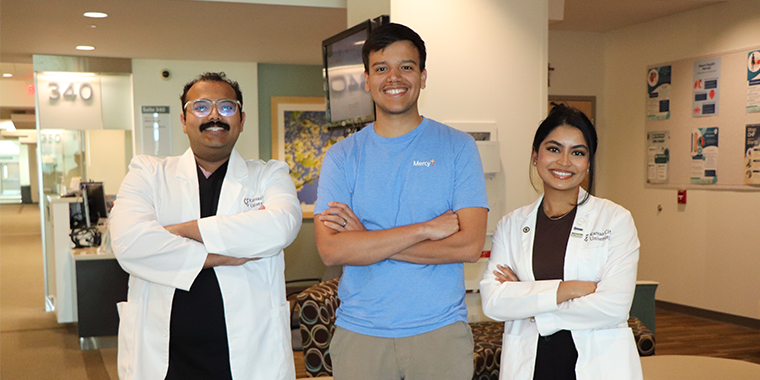
That question sits at the heart of a partnership between KCU-Joplin and Mercy Hospital Joplin. Through Student Health Advocates, KCU students serve patients living with chronic illnesses while gaining firsthand insight into the circumstances that can impact health outcomes long after a hospital stay ends.
For many patients, challenges such as a lack of transportation, medication costs or limited access to basic resources can make the next steps following discharge difficult. Others feel overwhelmed by the volume of information they receive before leaving the hospital.
That’s where student health advocates step in. They help patients make sense of discharge instructions, answer questions and confirm follow-up appointments. When additional assistance becomes necessary, they connect patients with Mercy's clinical teams and resource center, helping them stay on track with their recovery.
"There's almost always another reason why," said Melissa McAtee, director of operations for the KCU Center for Population Health and Equity. "I hope the one thing students take away from this experience is that they ask why when somebody isn't showing up for appointments or isn't following a treatment plan."
While patients benefit from additional guidance, students gain an educational experience that extends beyond traditional coursework. By reviewing medical records, interacting with patients and working alongside clinical teams, they apply classroom learning to real-world patient care.
Just as importantly, students discover that successful health care depends on far more than a diagnosis or treatment plan.
"A lot of times it isn't that someone doesn't want to take care of their health," McAtee said. "There are barriers in the way. We want students to understand those barriers and learn how to help address them."
For student doctor Anisha Ali, the experience has given her a new perspective on rural health care.
Originally from California's Bay Area, Ali said many of the barriers she encountered while working with patients in urban communities differ from those in southwest Missouri.
"It's definitely been a lot more informative for me to understand the differences in urban and rural disparities in patients," Ali said. "That's something that I never would have understood being back home."
Student Doctor Shantanu Amin echoes a similar sentiment. “The program has helped me see health care beyond just disease and medicine itself,” he added. “It’s preventive health care at its best.”
The initiative has produced measurable results. Patients who engage with student health advocates attend follow-up appointments more consistently, access available resources more readily and remain more engaged in managing their health. The program has also contributed to efforts aimed at reducing hospital readmissions among patients with congestive heart failure.
"Once patients get home, a lot can change," said Carlos McJunkins-Macias, quality improvement specialist at Mercy Hospital Joplin. "These calls help identify needs we may not know about until a patient returns to the hospital."
Those outcomes have fueled the program's growth. What started with five students now includes more than a dozen advocates, with plans underway to expand the program to patients with chronic obstructive pulmonary disease.
The partnership also provides students with meaningful exposure to Mercy physicians, clinicians and health care leaders throughout the area.
Several participants have continued clinical training within the Mercy system, and some hope to return to the region after residency training.
Along the way, students gain a deeper understanding of the circumstances that influence health once a patient returns home.
Often, the biggest obstacles to better health are the ones that can't be treated with a prescription.
Understanding those obstacles starts with a simple question:


(0) Comments