


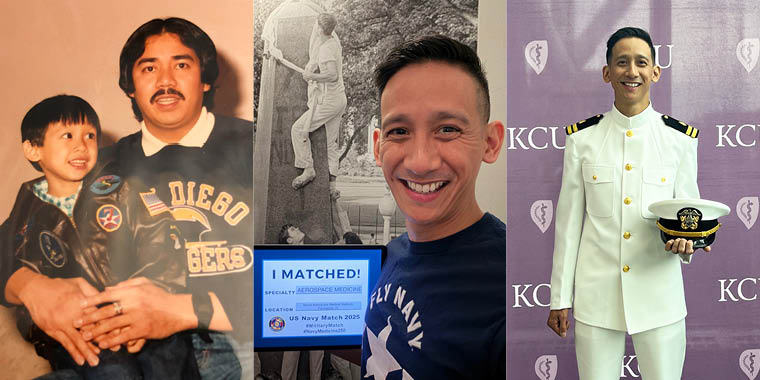
On Military Match Day at the United States Naval Academy, the weight of years of training came down to a single moment.
“I opened the email, and my mind just goes blank for a split second,” Jason-Flor Sisante recalled. “And then I start reading it, and the excitement just kept building when I realized I got my number one choice. It was exactly what I had been working toward for the last 10 years of my life.”
That top choice is one of the most competitive and specialized training pathways: the Navy’s aerospace medicine residency track. The program trains physicians for aviation, space and other austere environments of operational military medicine.
For Sisante, a Kansas City University (KCU) Class of 2026 College of Osteopathic Medicine graduate, Match Day marked the culmination of preparation that began decades earlier.
A self-described child of the ’80s, he grew up captivated by aviation and space, fueled by Top Gun, Star Wars and Star Trek. But what began as childhood fascination didn’t feel like a realistic career path until a pivotal visit to the Kennedy Space Center years later. While watching an IMAX film, something shifted.
“I remember sitting there thinking, wait…people actually do this for a living?” he said.
His curiosity led him to apply for a NASA internship, opening the door to a summer at Johnson Space Center. There, exposure to aerospace environments and conversations with senior neuroscientists and naval flight surgeons helped him realize a path forward that would give him the best shot to become a space doctor. His PhD training in rehabilitation science and osteopathic medical education at KCU gradually came together as part of a larger, intentional vision.
“Out of almost 200 Navy Health Professions Scholarship Program students nationwide, I think there are only three selected for this pilot aerospace medicine pathway,” said Sisante. “So, it really felt like everything had aligned to put me exactly where I wanted to be.”
Sisante will complete a family medicine internship at Naval Hospital Jacksonville and continue his residency training in aerospace medicine in Pensacola, Florida. There, he will train alongside Navy and Air Force flight candidates and gain firsthand experience in aviation medicine through flight clinics and research in operational military medicine that supports aviation and space exploration.
“I would love to be involved in Artemis missions or future Mars exploration,” he said. “NASA is like Disneyland for people who love science.”
He also serves as a NASA Solar System Ambassador, supporting public engagement in space science through outreach and participation on NASA review and judging panels for citizen science projects and internship programs.
Sisante says KCU helped reinforce clinical readiness and provided a strong support system that prepared him for a competitive residency placement and military medicine.
“I think the best years of my life have been in Kansas City,” he said. “I am an absolutely completely different person for the better.”
Beyond academics, he credits faculty, mentors and classmates with helping him navigate challenges and build confidence as a physician.
“You don’t really know what that fire hose is until it’s actually hitting you,” he said. “But you learn how to manage it. And that’s what prepares you for everything that comes next.”
(0) Comments